
Wednesday, 25 February 2015

Field Trip - DKS students
Understanding bio diversity
Students of class 7 came to the Mallasandra Campus to observe and learn more about the biodiversity in the school campus and to see the STP (Sewage Treatment Plant ) and water purifiers in school.Mr.Madhusudhan facilitated the session.Children learnt about data mapping and the significance of bio diversity.


Students of class 7 came to the Mallasandra Campus to observe and learn more about the biodiversity in the school campus and to see the STP (Sewage Treatment Plant ) and water purifiers in school.Mr.Madhusudhan facilitated the session.Children learnt about data mapping and the significance of bio diversity.
Friday, 16 January 2015
Celebrating Trees
Dear Students
"Neralu" is a tree fest happening in Bangalore.Here's an interesting activity that all of you can do,by working in teams.See the details given below and register your teams with your respective club Facilitators as soon as possible.All the Best :)
Neralu School Project - http://neralu.in/schools/
"Neralu" is a tree fest happening in Bangalore.Here's an interesting activity that all of you can do,by working in teams.See the details given below and register your teams with your respective club Facilitators as soon as possible.All the Best :)
Neralu School Project - http://neralu.in/schools/
Neralu invites all schools to engage in an exciting project to explore the world of trees and connect with nature. These trees, stand tall as our silent neighbours, and bear within them endless stories to share. From measuring trees to painting a wall with trees, this could be a fun and informal way of learning about our city’s rich natural heritage.
We encourage each and every school in the city to register, pick a suitable activity from the list provided, execute it with the help of students, teachers and parents; document it, and share it back with us. Let’s work together as one large community to be the voice for our tall, silent friends.
The activities help bring students outdoors and appreciate trees, thereby enabling them to observe and record the diversity of life. It's a hands-on activity and makes the learning more fun.
To participate, here are a few simple steps -
- From the list below, select the activity that you would like to execute at your school. (PDF's are attached on the website)
- Tree Scrapbook
- Measure a Tree
- Diversity of Life
- Value of a Tree
- Tree Census
- Tree Poster Collage
- Build a Tree
- Paint a Tree Mural
- Plant a Tree
- Register your school at www.neralu.in/schools and fill in the essential details within the registration page.
- Execute the project, document the process, and email a write-up with photographs to neralufestival@gmail.com
- 10 students per group is an ideal size. Some activities could be executed by a larger or smaller group too.
- Last date for Submission - 5th Feb 2015
- For the activities Tree Poster Collage and Tree Scrapbook, two entries from each school can be submitted to be displayed at various Neralu venues. The works can be collected back after Feb 15th at a designated pickup point.
- Selected entries will be featured on the Neralu website.
Sunday, 11 January 2015
Trip to an Organic Farm
Jan 10,2015
A group of excited students went to an Organic Farm ,Vanashree which is situated in Dodda MaralWadi village.(www.vanashree.in)
Children were taken on a campus tour and they touched week-old chicks,calves.They learnt about free-range chicken coop and about organic farming.Mr.Srikant who owns the farm explained about the role of insects and trees in the ecosystem.His son,Sriram was well versed with the ways of the Natural World and his wife,Prithi also showed the students around.The farmer couple,Shanmuga and Jaya with their son,Kishore stay permanently in the farm.
Text book concepts of Gobar Gas plant came out alive when Be2 Aware members saw the Gobar gas plant - children were pleasantly surprised that there was no foul smell.
Here are few photos that captured the visit :


A group of excited students went to an Organic Farm ,Vanashree which is situated in Dodda MaralWadi village.(www.vanashree.in)
Children were taken on a campus tour and they touched week-old chicks,calves.They learnt about free-range chicken coop and about organic farming.Mr.Srikant who owns the farm explained about the role of insects and trees in the ecosystem.His son,Sriram was well versed with the ways of the Natural World and his wife,Prithi also showed the students around.The farmer couple,Shanmuga and Jaya with their son,Kishore stay permanently in the farm.
Text book concepts of Gobar Gas plant came out alive when Be2 Aware members saw the Gobar gas plant - children were pleasantly surprised that there was no foul smell.
Here are few photos that captured the visit :
 |
| Add caption |
Monday, 22 December 2014
Merry X'Mas

Dear Be2 Aware Club Members
Have a merry X'Mas and a wonderful 2015.May every day see you grow into earth sensitive,earth friendly human beings.Spread environmental awareness in your homes,your locality.Spread goodness and cheer - Celebrate Life in harmony with Nature !!!
Friday, 19 December 2014
Special Assembly by former Be2 Aware Members
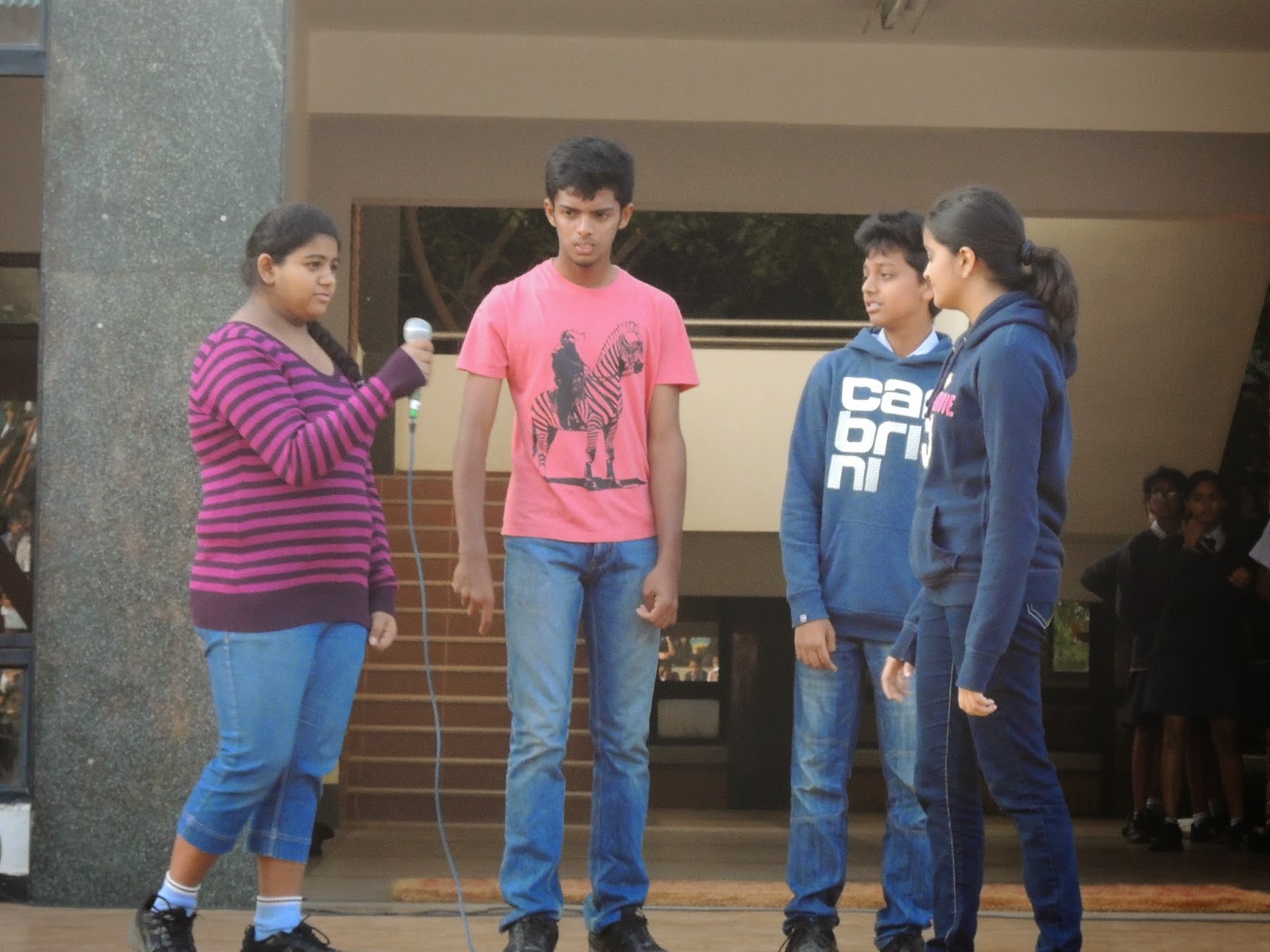
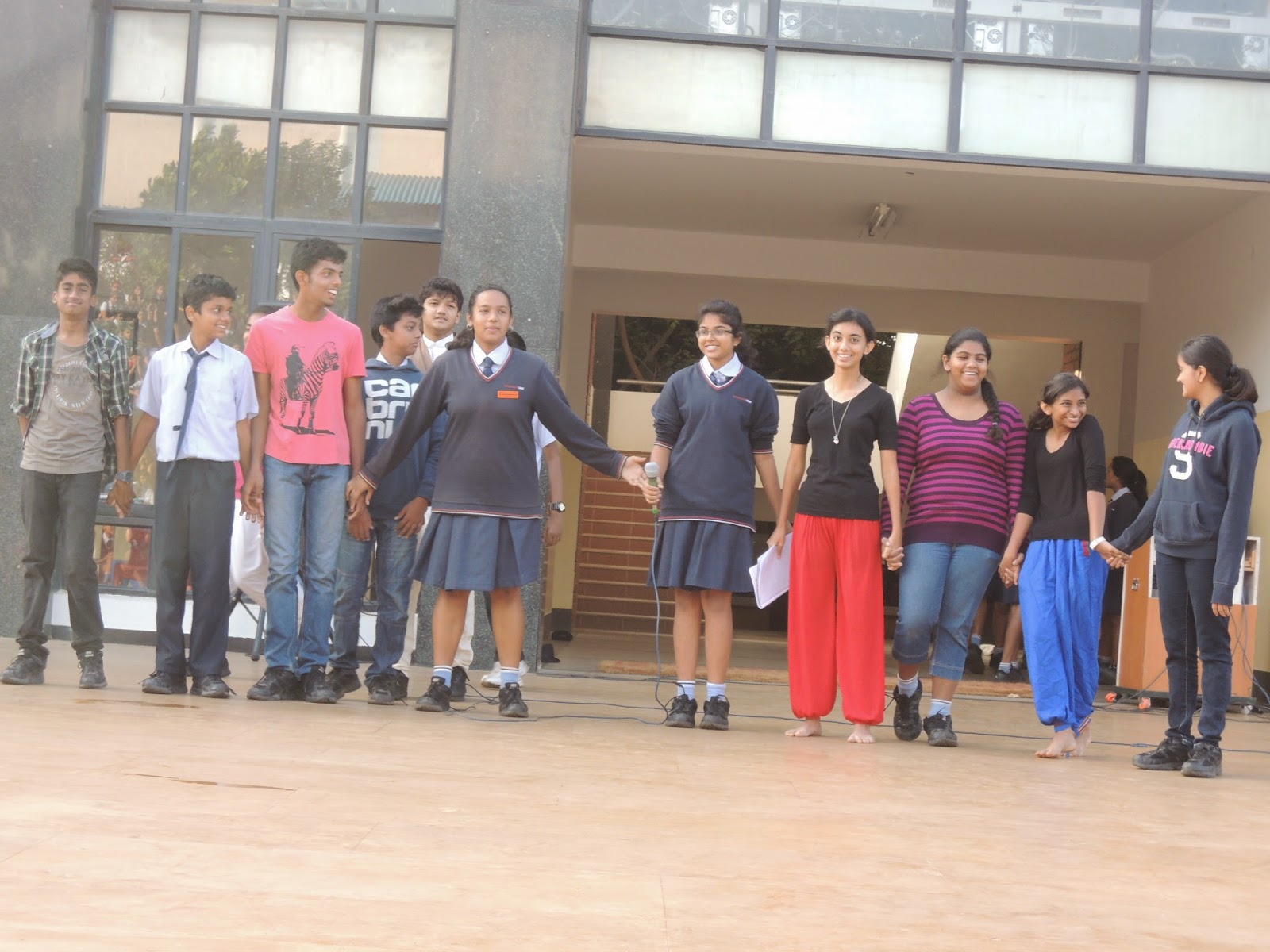
Students of class 9 performed the Special Assembly in the High School Block and the Junior Block on two different days - Dec 17 and Dec 18.The students spoke about "Swacch Bharat " - cleaning up the neighborhood and inspired their fellow students. Good work students :)Keep it up!!




Thursday, 11 December 2014
Shibori Technique
Dec 15,2014
Shibori was originally an art of the poor. In feudal Japan, many people could not afford to buy expensive fabrics like cotton or silk, so clothes were often made of cheap hemp fabrics. People could not afford to replace clothes regularly either, so they would repair and redye them, and the art of Shibori evolved as a means of making old clothes look new. Under the Tokugawa peace, many different arts flourished, and many different techniques and local forms of Shibori emerged. Shibori developed along two separate paths: as the method of decorating the silk used for producing kimonos for the aristocracy of Japan (largely carried out in Kyoto), and as a folk art differing from region to region.
Here are few more interesting links :
Ms.Neha Utmani conducted the session on "Shibori" - you can use this technique to create eco friendly gift wrappers that are exclusive.
Materials Required
Plain paper napkins,Rubber bands,Edible color powders,Brushes,bowl,cloth peg,1 rupee coins(2),old newspapers.
There is another interesting way of painting that is also meditative,called suminagashi - http://suminagashi.com/overview/.This site also talks of a Turkish - Islamic Art form called Ebru.
Thank you Neha Ma'am for the interesting session.You can view her sessions at : http://nehautmani.blogspot.in/
.JPG)


.JPG)


Shibori was originally an art of the poor. In feudal Japan, many people could not afford to buy expensive fabrics like cotton or silk, so clothes were often made of cheap hemp fabrics. People could not afford to replace clothes regularly either, so they would repair and redye them, and the art of Shibori evolved as a means of making old clothes look new. Under the Tokugawa peace, many different arts flourished, and many different techniques and local forms of Shibori emerged. Shibori developed along two separate paths: as the method of decorating the silk used for producing kimonos for the aristocracy of Japan (largely carried out in Kyoto), and as a folk art differing from region to region.
Here are few more interesting links :
Shibori -Traditional Craft- Part 1
Shibori -Traditional Craft- Part 2
Indigofera
Ms.Neha Utmani conducted the session on "Shibori" - you can use this technique to create eco friendly gift wrappers that are exclusive.
Materials Required
Plain paper napkins,Rubber bands,Edible color powders,Brushes,bowl,cloth peg,1 rupee coins(2),old newspapers.
There is another interesting way of painting that is also meditative,called suminagashi - http://suminagashi.com/overview/.This site also talks of a Turkish - Islamic Art form called Ebru.
Thank you Neha Ma'am for the interesting session.You can view her sessions at : http://nehautmani.blogspot.in/
Subscribe to:
Posts (Atom)